
What Is the Difference Between Generative Engine Optimization (GEO) and Search Engine Optimization (SEO)
The way people look for information on the internet is changing fast. We used to rely on search engines like Google to find what we need.. Now people are using other tools like ChatGPT, Google Gemini, Perplexity and Claude to get answers and make decisions.These tools are powered by intelligence and they are becoming the main way people find information.
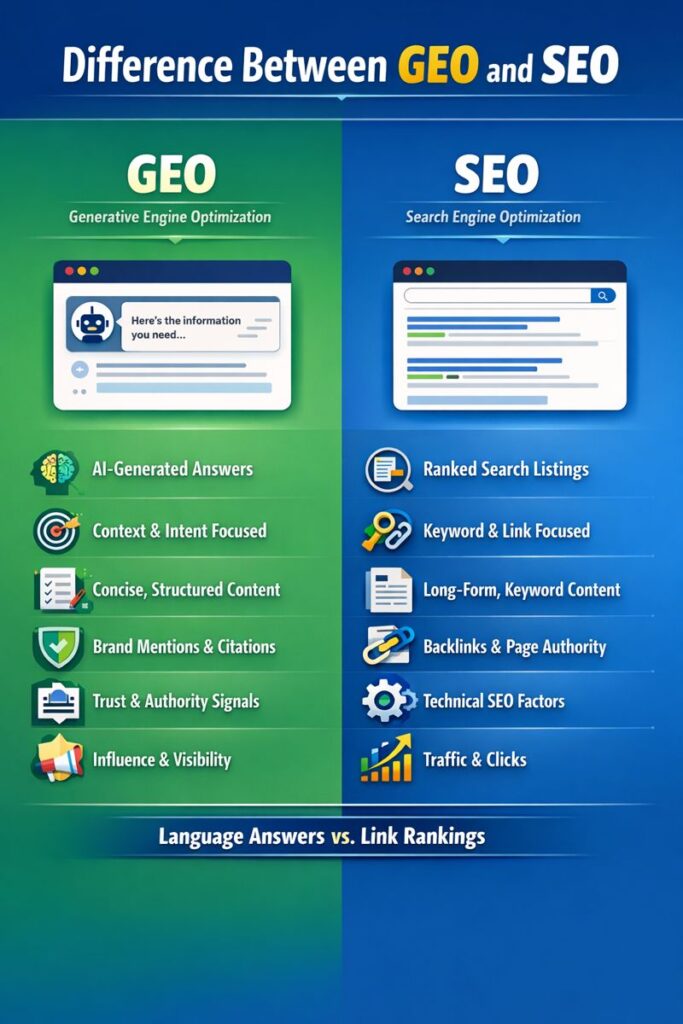
This change is leading to something called Generative Engine Optimization or GEO for short which is all, about Generative Engine Optimization. Generative Engine Optimization is a deal because it is related to how these new tools work.When we talk about SEO it is about getting websites to show up near the top of search engine results pages. On the hand GEO is about making sure content shows up and people can reference it in answers that are created by artificial intelligence.In this blog we will look at the differences between GEO and SEO and how each of them works. We will also talk about why businesses need to use both GEO and SEO if they want to stay of the competition, in the digital world.
1. What Is Search Engine Optimization (SEO)?
When you want your website to show up near the top of the list on search engines like Google and Bing you need to do something called Search Engine Optimization. Search Engine Optimization is the thing that helps your website get a spot on these search engines. So basically Search Engine Optimization is, about making your website better so it can rank higher on Google and Bing. This way when people search for something they can find your website easily because of Search Engine Optimization.
Key Objectives of SEO:
Increase organic website traffic
Improve keyword rankings
Enhance website authority and trust
Drive conversions and sales
How SEO Works:
Search engines use algorithms to figure out how good the content is based on:
Keyword relevance
Backlinks and authority
User experience (UX)
Page speed and mobile friendliness
Content quality and freshness
Common SEO Elements:
On-page SEO (titles, meta descriptions, headings)
Technical SEO (site structure, schema, indexing)
Off-page SEO (backlinks, brand mentions)
Local SEO (Google Business Profile, reviews)
Search engine optimization has been the foundation of marketing for, over twenty years and it is still very important. Search engine optimization is something that people use to get their websites to show up near the top of search results. This is why search engine optimization still matters.
2. What Is Generative Engine Optimization (GEO)?
The Generative Engine Optimization process is, about making content so that computer programs that search for things and big language models can understand the Generative Engine Optimization content trust the Generative Engine Optimization content and use the Generative Engine Optimization content when they are giving answers.
Generative engines do not rank links like search engines do. Instead these generative engines give you answers, to your questions. They provide the information you are looking for without making you go through a list of links. The generative engines generate answers so you can get what you need quickly.
Key Platforms Influencing GEO:
ChatGPT
Google Gemini
Perplexity AI
Claude AI
Microsoft Copilot
Main Goal of GEO:
Get your brand, content, or insights mentioned or cited inside AI-generated responses
GEO is really about making sure things are clear and easy to understand that the information comes from a source and that the facts are correct. It is not, about putting the right words in the right places. GEO cares about clarity, authority and factual accuracy.
3. Core Differences Between GEO and SEO
1. Search Output Format
When you do a search the Search Engine Optimization displays a list of ranked links. This means the Search Engine Optimization shows you a list of links that are ranked in order. The Search Engine Optimization is really good, at displaying a list of ranked links so you can find what you are looking for.
GEO: Generates a single, synthesized answer
2. User Behavior
People do searches, on the internet. They click on links to get to other pages. They browse these pages to find what they are looking for. SEO is important because it helps people find the pages they need when they click on links. When users click on links they want to see pages that have what they need.
GEO: When people use this they get answers away without having to click anything. The GEO system is really good, at giving users answers without making them click.
3. Content Consumption
When it comes to SEO people like content that is long and has a lot of keywords in it. This type of content does well. SEO is about making content that people want to read and this is what long-form and keyword-rich content does. It is good, for SEO because it has a lot of information that people are looking for.
When it comes to the GEO people like to read content that’s short and to the point. The GEO is about having a structure to the information. This means the GEO should have facts that’re easy to understand. For the GEO the best kind of content is the kind that gets straight, to the point and does not waste time on things that’re not important. The GEO is better when it is based on facts that’re true and can be trusted.
4. Traffic Flow
Search Engine Optimization is really important. It helps people find your website when they search for something SEO brings users to your website.This is how it works: when you use SEO your website shows up near the top of the search results.So when people search for something they can find your website easily.
SEO brings users to your website. That is a good thing.GEO helps people know about a brand. It does this without making sure people click on the brand. The goal of GEO is to make a brand well known. GEO does this even if people do not click on it.
4. Optimization Focus: GEO vs SEO
SEO Optimization Focus:
Target keywords
Keyword density
Backlink building
Page authority
Technical performance
GEO Optimization Focus:
Entity-based content
Clear definitions and explanations
Structured formatting (lists, steps, FAQs)
Trust signals (citations, statistics)
Topical authority
Search engine optimization asks:
I want to know if this page can rank higher. The thing I am talking about is this page. I want it to be, at the top of the search results. So my question is can this page actually rank higher than it does now. I am hoping this page will be number one.
GEO is asking:
I want to know if I can really trust this information to get the answer. Is this content a source, for what I am looking for? Can I use this content to get an answer?
5. Keyword-Based vs Context-Based Optimization
SEO: Keyword-Centric
Focuses on exact-match and long-tail keywords
Uses tools like Google Keyword Planner and Ahrefs
Optimizes headings, URLs, and meta tags
GEO: Context & Intent-Centric
Focuses on meaning, intent, and relationships
Uses natural language
Answers questions fully and clearly
Prioritizes semantic relevance over keyword repetition
GEO vs SEO Difference
Generative AI search is really different from the search engine optimization. Traditional search engine optimization is about making your website show up near the top of the list when people search for something on the internet.Generative AI search on the hand is like a computer program that can understand what you are looking for and generate the answer for you. It does not just give you a list of websites like search engines do.
The main difference between AI search and traditional SEO is that generative AI search uses artificial intelligence to create the answer. Traditional SEO is about getting your website to the top of the list so people can see it and click on it.Generative AI search is changing the way we search for things on the internet. It is making it easier for people to find what they are looking for because it can understand what they mean.For example when you ask an AI search engine a question it will give you a direct answer instead of giving you a list of websites that might have the answer. This makes it really convenient for people who do not want to spend a lot of time searching for something on the internet.
Generative AI search is also very good at understanding language. This means you can ask it a question in a way like you would ask a person and it will understand what you mean.Overall generative AI search and traditional SEO are two things. Generative AI search is a way of searching for things on the internet that uses artificial intelligence to generate the answer. Traditional SEO is, about getting your website to show up near the top of the list when people search for something.
6. Content Structure Differences
SEO-Friendly Content:
Keyword-optimized headings
Internal and external links
Text that is used to describe an image is called image alt texts. These image alt texts are very important for people who cannot see the image. The image alt texts tell people what the image is about. Image alt texts are also useful for computers that are searching for information on the internet.
* They help computers understand what the image is
1. Image alt texts are used by people who use computers that read out text
Image alt texts are used to make the internet a better place for everyone. The image alt texts are, like a description of the image.
Long-form articles
GEO-Friendly Content:
Clear definitions at the top
Bullet points and numbered lists
Question-and-answer sections
Simple language
Neutral, factual tone
AI engines prefer content that’s simple to understand.
AI engines, like it when people write in a way that’s easy to read.
The things that AI engines prefer in content include:
* Being straightforward
* Using words
AI engines do not like complicated sentences or big words that people do not use in everyday life.
AI engines prefer it when you write about AI engines in a way.
Easy to summarize
Factually consistent
Logically structured
7. Authority and Trust Signals
SEO Trust Signals:
Domain authority
Backlink quality
User engagement metrics
HTTPS and security
GEO Trust Signals:
Clear author expertise
People are talking about brands over the internet.
There are lots of brand mentions, across the web.
The brand mentions are found on different websites.
Consistent factual data
Up-to-date information
Transparent sources
When it comes to GEO having credibility is really important. It matters more than having a lot of backlinks, for GEO. People trust GEO when it is credible.
8. Measurement and Success Metrics
SEO Metrics:
Organic traffic
Keyword rankings
Click-through rate (CTR)
Bounce rate
Conversions
GEO Metrics:
When the computer program gives a response it sometimes talks about brands. These brand mentions in the AI responses are interesting because they show what the computer program thinks is important. Brand mentions in AI responses can be about anything like a company or a product. The computer program uses brand mentions in AI responses to make the conversation more real.
* The brand mentions in AI responses can be from a company
* The brand mentions in AI responses can also be, from a company
The brand mentions in AI responses are a key part of how the computer program works. Brand mentions in AI responses help the computer program sound more human like.
Citation frequency
Content reuse by AI tools
Visibility across generative platforms
GEO success is about influence, not just traffic.